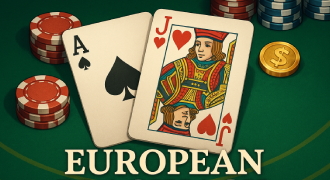
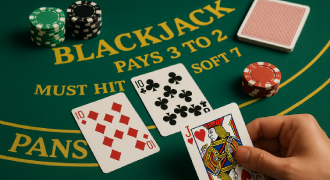
Play European Blackjack – Unique Rules and Better Odds
A clean ruleset, lean house edge, and transparent decision points make this variant a smart play European Blackjack online for anyone who treats the table like a KPI dashboard. You get streamlined mechanics, fast cycle times, and minimal ambiguity around risk. Because the dealer delays the second card, your choices drive the P&L, not guesswork. Align that with disciplined bankroll governance and you have a measurable edge that scales from sandbox sessions to high-stakes execution.
Overview of European Blackjack
European Blackjack consolidates complexity into a crisp, operational rulebook built for low friction and high clarity. The casino game typically uses two decks, a dealer who stands on 17, and a no-hole-card model that influences risk after your decisions. Sessions run quickly, which lets you iterate decisions and improve your baseline metrics. Apply basic strategy to standardize choices and remove emotion from the pipeline.
- Decks: commonly 2 (some venues use 4–8)
- Dealer behavior: stands on soft 17 (S17) in most tables
- Hole card: none until after player actions (ENHC model)
- Doubling: usually on 9–11; doubling after split often restricted
|
Item |
Value (Typical) |
Impact On Player |
|
Deck Count |
2 |
Lower card dilution; tighter variance |
|
Blackjack Payout |
3:2 |
Core ROI driver; avoid 6:5 tables |
|
Surrender |
Rare |
Plan decisions without relying on surrender |
|
Split Limit |
Usually 1 split |
Controls exposure; Aces receive one card |
|
Double After Split |
Often Not Allowed |
Sequence doubles only when permitted |
|
Insurance |
Offered; use selectively |
Negative EV unless count-driven |
For orientation, note that European style Blackjack uses the delayed dealer card to define downstream outcomes. In simple terms, you act first, then the dealer reveals, which tightens risk management. For newcomers, this structure reduces decision noise while keeping the pace brisk. As a result, your learning loop shortens and outcomes become more predictable over time.
What Makes European Blackjack Stand Out?
This variant differentiates itself through the no-hole-card procedure, which turns every choice into a clear micro-investment. Because the dealer only draws the second card after you act, doubling and splitting require sharper discipline. That structural style variation shifts the edge a fraction toward the house unless you optimize decisions. In exchange, the online casino game delivers transparent cause-and-effect, which is ideal for players who benchmark performance.
Compared to most American tables, you’ll often see tighter limits on European Blackjack splitting and doubling. This reins in speculative lines and favors players who prefer controlled risk. Pace is efficient: fewer decks and leaner rules mean more hands per hour and more chances to apply your framework. Over time, that throughput compounds the value of good decisions.
Finally, table selection matters more than in many variants. Small toggles—S17 vs H17, double-on-any-two vs 9–11 only—move expected value in measurable ways. Map those toggles before you sit down so your plan aligns with the ruleset.
Core Rules That Define the European Variant
The European Blackjack rules revolve around ENHC (European No Hole Card), limited splits, and typically S17. Blackjack pays 3:2; insurance exists but erodes value without a count signal. Doubling usually locks to totals of 9–11, and double after split is often off the table. If the dealer reveals a natural after you’ve doubled or split, all associated wagers are lost under ENHC.
|
Rule Element |
European Variant (Typical) |
American Variant (Typical) |
|
Dealer Hole Card |
No (revealed after players act) |
Yes (peeks for Blackjack) |
|
Dealer Stands On Soft 17 |
Yes (S17) in many casinos |
Often H17 |
|
Double |
On 9–11 (sometimes 10–11) |
On any two cards |
|
Double After Split |
Usually Not Allowed |
Commonly Allowed |
|
Splits |
Usually one split; Aces one card |
Up to three splits; Aces one card |
|
Surrender |
Rare |
Available at some tables |
|
Blackjack Payout |
3:2 (avoid 6:5) |
3:2 or 6:5 |
These constraints streamline play and reward disciplined decision-making. They also make variance more predictable across sessions. With a consistent framework, you can track accuracy, identify leaks, and roll improvements into the next sitting. That feedback loop is where the edge shows up.
How to Play European Blackjack: A Step-by-Step Walkthrough
This step-by-step walkthrough provides a crisp operating model for European Blackjack, converting each hand into an actionable decision tree aligned with EV targets and risk controls. Follow the sequence—bet sizing, player actions, and ENHC resolution—to standardize execution and lift performance like a well-run product rollout.
- Step 1: Pick Your Bet Size
Start by setting a unit size that matches your bankroll and risk tolerance. Many players anchor at 1–2% of total funds per hand to protect runway. Pre-commit to a ceiling for doubles and splits so your exposure doesn’t spike under ENHC. Document your staking plan like a budget line—clarity up front prevents mid-hand drift.
- Step 2: Dealer Deals Two Cards – No Hole Card Yet!
You receive two cards face up; the dealer shows one upcard. There is no hidden dealer card at this stage, which means you act with incomplete information by design. This structure emphasizes reading the upcard and your total, rather than worrying about peeks. Treat the upcard as your market signal and calibrate moves accordingly.
- Step 3: Choose – Hit, Stand, Double, or Split
Your European Blackjack action should follow a rule-driven playbook, not vibes. Hitting seeks more equity when your total is weak; standing locks value when the dealer is likely to bust or you’re already strong. Doubling concentrates capital when math says your edge spikes, but remember ENHC raises downside if the dealer flips a Blackjack. Splitting turns one marginal spot into two optimized hands, yet keep it selective under the tighter split limits.
- Step 4: Dealer Reveals Second Card After Your Move
After all player actions, the dealer draws the second card and then completes their hand. This is the pivotal ENHC moment: prior doubles and splits stay live while the dealer resolves. If a natural appears, the table resolves per house policy, which usually means all wagers on that round are lost. Build that assumption into your risk plan to avoid surprise volatility.
- Step 5: Who Wins? Final Hand Comparison
If neither side has a Blackjack, totals decide the outcome. Hands over 21 bust; otherwise, the higher total wins, with 21 as the cap. Your Blackjack pays 3:2, which is a core profitability lever over long horizons. Pushes return your stake and keep your cycle time efficient for the next decision.
Top Tips for Winning at European Blackjack
Anchor your decision-making in European Blackjack basic strategy tailored to ENHC and S17. Use a Blackjack chart that matches the table toggles; a mismatch undermines EV immediately. When in doubt, escalate to a condensed European chart to sanity-check borderline doubles and splits. As you refine a European strategy, log hands, tag mistakes, and iterate weekly—treat improvement like a product roadmap.
- Prioritize S17, 3:2 payout tables; avoid 6:5 entirely.
- Double aggressively on 10 vs dealer 9 or lower, but respect ENHC risk on Ace upcards.
- Split 8s and Aces on sight; avoid splitting 5s or 10s.
- Skip insurance without a count signal; it’s a negative-EV detour.
- Keep session length fixed to control fatigue and maintain execution quality.
|
Situation |
Recommended Action |
|
Hard 9 vs Dealer 3–6 |
Double |
|
Hard 10 vs Dealer 2–9 |
Double |
|
Hard 12 vs Dealer 4–6 |
Stand |
|
Soft 18 vs Dealer 2, 7–8 |
Stand |
|
Soft 18 vs Dealer 3–6 |
Double |
|
Pair 8-8 vs Any |
Split |
This table is a quick reference, not a substitute for full European Blackjack strategy. Always align the chart with the exact table ruleset, then lock your decisions. Consistency compounds; ad-hoc moves do not.
For real money or for free
You can engage via online play in demo mode or step up to real money stakes when your process is stable. Many platforms let you enjoy European Blackjack online with toggles for table limits, speed, and a multihand game option to increase throughput. If you’re sharpening skills, free Blackjack sessions let you pressure-test decisions without capital risk. When your metrics are green, graduate to European Blackjack real money tables with the same discipline you used in practice.
Define the objective for each session—learning reps or profit execution—and pick the table accordingly. Demo environments are ideal for testing edge cases and new lines. Live tables validate your system under real conditions and time pressure. Keep the playbook identical across modes so you don’t introduce process drift.
Final thoughts on European Blackjack
This variant rewards players who favor structure over spontaneity. The ENHC mechanic adds accountability to doubles and splits, but a rule-first approach neutralizes the risk. Select the right table, apply your chart, and manage stake sizing like a pro. Do that consistently, and European Blackjack becomes a measured, scalable way to deploy skill on the felt.
FAQ
Is European Blackjack a good starting point for new players?
Yes; the rules are streamlined and the feedback loop is fast. The clear structure accelerates learning.
Why doesn’t the dealer take a hole card upfront?
It’s the ENHC model, which resolves the dealer hand after players act. This design keeps the flow simple and fast.
Can I apply American Blackjack strategies here?
Mostly, but adjust for ENHC and stricter doubling/splitting. Use a European Blackjack chart specific to this ruleset.
What odds can I expect in this version?
With S17, 3:2 payouts, and two decks, the house edge can sit near 0.5% with optimal play. Table settings move that number.
Is card counting still possible with these rules?
Yes, though fewer decks help and ENHC slightly complicates risk on doubles. Counting remains an advanced technique.
Are live dealer tables available for European Blackjack?
Yes, many casinos offer live lobbies with this ruleset. Verify S17 and payout terms before you buy in.