Come Bet in Craps – Rules, Odds & Strategy
The dice game moves fast, but it rewards structure. The come bet in Craps mirrors the pass line once a point is on, letting you build a position that spans multiple rolls. This concise explanation covers strategy, payout math, and layout position so your betting is precise from the first dice toss—plus how to place it, how zero-edge backing trims the house edge, when to prefer it over the pass line, and typical U.S. minimums, maximums, and RTP.
What Is a Come Bet?
At its core, the post-point entry play is the Pass Line’s twin, activating once the point is established. The post-point entry wager is a contract-style play that turns the next roll into your personal come-out, even mid-hand. Place chips in the marked “COME” area; on that next roll, 7 or 11 wins, 2, 3, or 12 loses, and any other number becomes your personal point.
For anyone curious about the post-point entry play in the dice game, imagine two timelines: the table’s point keeps running while your stake spins up its own mini-round. The dealer moves your stack to 4, 5, 6, 8, 9, or 10 if rolled, and you’re now rooting for that box to hit before a 7. And to answer searches for what is come bet in Craps: it isn’t a one-roll bet—it converts to a point bet, and you can (and usually should) add free odds for 0% house edge on the odds portion, which is why it’s popular in U.S. live and online play.
How to Place a Come Bet on the Table
Mechanically, placing a come bet on Craps is simple. Wait until the puck shows “ON” (the table has a point). Put your chips in the “COME” area right in front of you and the dealer will leave them there until the next roll decides their fate. If a natural (7 or 11) appears, the dealer pays you even money. On 2, 3, or 12, the wager is taken by the house. If a box number hits, the dealer moves your stack to that box—you now control that number.
Once your entry wager moves to a box, you can add zero-edge backing directly behind it. Most U.S. tables allow at least 3-4-5× backing (up to 3× behind the 6/8, 4× on the 5/9, and 5× on the 4/10), and many permit 2×, 5×, 10×, or more. Because this backing pays at true mathematical multiples and carries 0% house edge, it meaningfully lifts your overall return relative to the total stake.
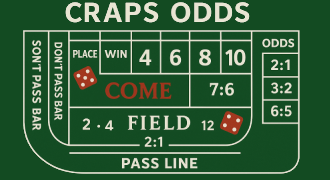
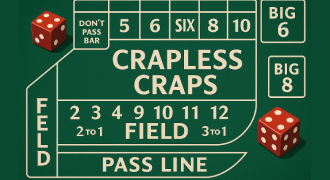
Where is the Come bet on the table?
Look in the center third of the layout between you and the stickman; the word “COME” is clearly printed. You place chips there whenever the puck is “ON.” After the deciding roll, if a box number is thrown, the dealer picks up your stack and centers it in the number box (4, 5, 6, 8, 9, or 10). That movement marks your personal point and starts the next phase. This is also a good spot to log your first planned use of come bet Craps so you can visualize how it moves from the COME area to its destination number.
Chips Handling & Dealer Interaction
Signal the wager and slide your chips into the box labeled “COME” so the dealer can see the amount. Once a number is set, ask for zero-edge backing and place the extra chips neatly behind your traveling stack. For bigger stacks or if unsure, say, “Backing on my six for $30, please,” and let the dealer set it. Clear calls keep payouts correct and the game quick, friendly, and accurate.
How the Come Bet Works Step-by-Step
The simplest way to lock in the sequence is to match the table’s rhythm—if you’re wondering whats a come bet in Craps, picture this: place a late-entry wager while the puck is ON; the next roll becomes your personal come-out (7/11 win, 2/3/12 lose), and any box number becomes your point. Once your chips land there, you’re in a race to hit that number again before a seven.
|
Next Roll |
Flat Portion Outcome |
Payout |
Note |
|
7 |
Win |
1:1 |
Resolves immediately; this come bet is finished |
|
11 |
Win |
1:1 |
Same as 7—instant resolution |
|
2 |
Lose |
— |
Chips are removed |
|
3 |
Lose |
— |
Chips are removed |
|
12 |
Lose |
— |
Reminder: “bar 12” applies to Don’t Pass/Don’t Come, not to Pass/Come |
|
4 / 5 / 6 / 8 / 9 / 10 |
“Travels” to that box |
— |
Your personal point is set; now you want a repeat before a 7 |
Timing After Point Is Set
A common question—what’s the come bet in Craps during the table’s point? Think of it as a modular Pass Line bet you can drop in anytime after the point. Since it fires on the very next toss, you can layer a sequence of post-point entries across successive rolls to “populate” several numbers. That staggered cadence is the hallmark of this entry play—you’re not front-loading; you’re scaling in gradually.
Establishing Your Come Bet Point
If you’ve ever searched Craps come bet explained, know that “establishing” means a 4, 5, 6, 8, 9, or 10 appears right after your chips sit in the COME. The dealer slides your stack to the matching number. From there, keep it simple: add zero-edge backing and root for repeats. If the box repeats, flat pays 1:1 and the backing pays its true multiple; if a 7 comes first, both portions drop.
Resolution on Future Rolls
Once set, your bet resolves only if the shooter rolls your personal point or a 7. That’s the whole come bet Craps explained flow: enter during an “ON” puck, wait one roll to see if you travel, then sit tight until your number repeats or a seven ends the story. Between those endpoints, your bet acts independently of the table’s Pass Line, which is why players use it to diversify outcomes and smooth volatility.
Come Bet vs Pass Line Bet
Both wagers share the same DNA: a flat bet with a 1.41% house edge and the option to add zero-edge backing (0% edge on that portion). The key difference is timing. Place the Pass Line before the come-out; the post-point entry wager goes down when the puck shows ON. That means you can build positions progressively with the come, whereas the Pass Line commits before any number is set. This gradual entry appeals to players who like risk staged over time.
The Pass Line energizes the opening because naturals pay instantly; the post-point entry play gives the same jolt, but on the very next toss after you enter. In practice, veterans mix both: open on the Pass Line for the come-out, then layer a few late-entry wagers to cover two or three box numbers. This section also marks the second planned use of come bet Craps as a label for the technique of synchronizing both bets.
Come Bet Odds and Payouts
The flat portion of the entry play pays 1:1 when your number repeats. The backing behind it pays at true multiples: 4/10 → 2:1, 5/9 → 3:2, 6/8 → 6:5. Repeat the payout ladder aloud to lock it in—2:1 on the outside numbers, 3:2 in the next ring, 6:5 on the 6/8 inside. Since zero-edge backing carries a 0% house edge, the more you add relative to the flat portion, the better your combined return.
When people ask about come bet odds Craps, they’re usually comparing the effective RTP of different odds levels. The flat portion has a 1.41% house edge (RTP 98.59%). Adding 1× backing lowers the overall edge on total money to about 0.85% (RTP ≈ 99.15%). At 2× it’s ~0.61% (RTP ≈ 99.39%), at 3× ~0.47% (RTP ≈ 99.53%), at 5× ~0.33% (RTP ≈ 99.67%), and at 10× ~0.18% (RTP ≈ 99.82%). In short, zero-edge backing is your strongest lever.
Payout & Backing Summary (True multiples apply to the backing only):
|
Point Number |
Flat Come Bet Payout |
Odds Payout (True Odds) |
Notes |
|
4 or 10 |
1:1 |
2:1 |
Hardest box numbers; highest odds payout |
|
5 or 9 |
1:1 |
3:2 |
Middle difficulty |
|
6 or 8 |
1:1 |
6:5 |
Easiest to roll; lowest odds payout |
Typical U.S. table minimums range from $5 to $25. On the high end, standard tables often cap flat bets at $1,000 to $5,000, while high-limit pits may accept $5,000 to $10,000 or more. Limits typically follow 3-4-5×, though some rooms permit 10×, 20×, or even 100× multipliers.Always confirm the posted sign so your plan matches the actual limits.
Best Come Bet Strategies
If you’ve looked for Craps come bet strategy, you’ve likely seen two guiding ideas: (1) use free-odds aggressively within your budget, and (2) build positions gradually so variance doesn’t blindside you. Each method below assumes disciplined bankroll management and steady base sizing.
Begin with a single entry play, let it travel to a box, add zero-edge backing, then consider a second entry. Two or three active numbers with max backing is a classic blend of coverage and efficiency. If your table minimum is $15 and you’re comfortable with 3-4-5× backing, a plan like $15 flat with $45 behind the 4/10, $40 behind the 5/9, and $36 behind the 6/8 keeps the math clean and payouts easy to verify.
Hedge Bets
Hedging can smooth swings with tiny offset wagers against immediate losses. For instance, some players add a small “any 2/3/12” side wager on the same roll as a fresh entry play to cushion those totals. But the “any 2/3/12” side wager carries a steep house edge, so keep hedges tiny and brief; in a disciplined come bet Craps approach, the core remains flat entries supported by full, zero-edge backing.
Placing Odds Behind Come Bets
Treat zero-edge backing as your value ladder. Max it out before adding new flat bets, especially with a limited session bankroll. Because this portion has a 0% house edge, it boosts blended RTP—for example, a $15 entry backed by $45 on the 4/10 keeps the flat’s 1.41% edge while adding a neutral-EV $45. Over time, that emphasis lowers cost per roll versus stacking many small flats without odds—this is the quiet power behind smart use of Craps come bet odds.
Stacking Multiple Come Bets
After the first box is live with backing, add a second late entry and repeat. Two numbers with full backing are the sweet spot. Three numbers pushes coverage further but also raises exposure to a seven. Treat a three-number build as situational—great when the table rhythm is steady. This section’s example marks our third planned, careful reference to come bet Craps as a shorthand for the multi-number approach many players adopt.
Combining with Don’t Come and Place Bets
Advanced players may mix small Don’t Come positions or use Place bets selectively to fine-tune pace and variance. For example, some will Place the 6/8 for speed while waiting for a post-point entry to land on an outside number. Others will play a tiny Don’t Come during choppy streaks to act as a brake. Whatever you blend, keep the math in view and remember the golden rule: the dice do not remember—your edge comes from structure, not superstition.
Advantages and Flexibility
For anyone asking what is the come bet in Craps, it’s a flexible entry: skip the come-out, enter later, scale your position, then take true odds on your number to lift RTP for any style.
Drawbacks: early 2/3/12 results can sting the entry, and a quick seven can sweep 2–3 numbers—match the shooter’s rhythm, keep units steady, and set stop-loss and win targets in advance.
Pros:
- Flexible entry after the point is on
- Access to 0%-edge backing; lifts overall RTP (e.g., ~99.67% at 5× backing)
- Scales across two or three numbers for diversified hits
- Simple payouts (1:1 on the flat; backing pays at true multiples)
Cons:
- Vulnerable to an immediate 2/3/12 result on the entry roll.
- A fast seven can sweep multiple active numbers at once
Low House Edge
On the flat portion, the house edge is 1.41%, which corresponds to an RTP of 98.59%. That’s already friendly compared with many table games. Adding zero-edge backing introduces a 0%-edge component, lowering the blended house edge on total money to about 0.85% at 1×, ~0.61% at 2×, ~0.47% at 3×, ~0.33% at 5×, and ~0.18% at 10×. While no wager can guarantee profit, this profile is among the most efficient ways to buy action in a casino.
|
Odds Multiple |
Effective House Edge (≈) |
RTP (≈) |
|
0× (flat only) |
1.41% |
98.59% |
|
1× |
0.85% |
99.15% |
|
2× |
0.61% |
99.39% |
|
3× |
0.47% |
99.53% |
|
5× |
0.33% |
99.67% |
|
10× |
0.18% |
99.82% |
Use Across Multiple Rolls
Wondering what is a come bet in Craps? It’s a point bet that waits for repeats, so it can persist across many rolls and score multiple hits when you re-enter after each resolution. This multi-roll nature suits patient bankroll management: rather than banking on a single swingy outcome, you build a small network of independent chances that resolve as the shooter works through the hand.
Is a Come bet a good bet?
For most players who want low, predictable cost per dollar of action, yes. The entry play’s flat portion matches the Pass Line’s edge, and the option to add zero-edge backing makes it one of the most mathematically efficient choices on the layout. It’s easy to learn, easy to verify, and the payouts are transparent. This is also where we place our fourth planned reference to come bet Craps, emphasizing it as a core, mainstream option for disciplined players who value clarity and control.
Context matters. With a tight bankroll, limit simultaneous numbers and prioritize max backing behind one or two points; deeper pockets can run three numbers with full backing. Set limits, size wagers to your comfort, and remember: structure and patience beat hunches. Stick to a plan, and your chance of long, steady sessions improves even when short-term results swing.
FAQ
Can I place multiple Come Bets at once?
Yes—one per roll while the puck is ON; two numbers with full backing is common, a third only if comfortable.
What happens to my Come Bet on a 7?
After it travels: you lose the flat + backing; on the deciding roll: you win even money.
Can I remove a Come Bet after placing?
Flat after travel—no; backing—yes (reduce/remove anytime; confirm house rules).
Should beginners prefer Come or Place Bets?
Start Pass Line; add a post-point entry with zero-edge backing for a lower blended edge; Place bets are removable—master one style, then mix.